





If you’re running an online store, you already know how competitive the landscape is. With thousands of brands fighting for the same audience, your survival depends on one thing—visibility.
Every scroll your customer makes is a battle you must win, and every product page is a chance to turn curiosity into revenue.
In a world where attention spans are shrinking and choices are endless, only the smartest brands rise above the noise.
That’s exactly why mastering Ecommerce SEO isn’t optional anymore—it’s the foundation of sustainable growth. Unlike regular SEO, SEO for ecommerce demands a more strategic, product-focused approach to help you stand out, attract organic traffic, and convert more customers.
The Foundation of Search Engine Optimization for Ecommerce
Ecommerce SEO works differently from general SEO because online stores are larger, dynamic, and structured around product-driven navigation. With dozens or sometimes thousands of product pages, category pages, filters, and attributes, every element influences discoverability. Without a strong foundation, ranking becomes an uphill battle.
Key differences between ecommerce and regular SEO:
- Ecommerce content changes frequently.
- There are more pages competing for visibility.
- Duplicate content risks are higher.
- Technical SEO has a stronger impact.
- Product intent requires very specific keyword targeting.
Understanding these differences helps you build a strategy tailored to how online shoppers search and how search engines evaluate ecommerce sites.
Building a Strong Keyword Strategy for Search Engine Optimization for Ecommerce
Keywords are the backbone of every successful ecommerce SEO campaign. But unlike traditional websites, ecommerce stores require keywords that match buying behavior. People searching for products often use descriptive, intent-heavy queries. That’s why your keyword strategy must focus on the terms that signal readiness to buy.
Focus on keywords that convert:
- Transactional keywords: “buy”, “discount”, “free shipping”
- Product-specific queries: “blue running shoes men’s”
- Long-tail phrases with clear intent: “best noise-cancelling headphones under $200”
Using tools like Ahrefs, SEMrush, and Amazon suggestions helps uncover exactly what customers type before making purchases. Optimizing product and category pages around these terms ensures your store appears at the moment of buying intent.
Crafting High-Impact Product Pages With Modern Ecommerce SEO Concepts
A compelling product page blends SEO, persuasion, and user experience. Search engines must understand the page, and customers must feel confident enough to buy.
Begin with a clear, keyword-rich H1 that describes the product. Follow this with a well-structured description that speaks directly to the buyer. Instead of stuffing keywords, integrate them naturally while highlighting benefits, use-cases, material, or special attributes.
Elements that make a product page rank and convert:
- A descriptive H1 with the core keyword
- Keyword-rich subheadings such as features, benefits, and FAQs
- High-quality visuals with descriptive alt text
- Structured product data (schema)
- Unique descriptions rather than duplicated manufacturer text
These elements not only boost rankings but also reduce bounce rates by guiding customers naturally through the page.
10X your sales with powerful Ecommerce SEO Tips
Site Architecture: Key Ecommerce SEO Approaches for Better Crawlability
A strong site architecture makes it easy for search engines to crawl and understand your store. It also improves user engagement because shoppers can find products faster. Aim for a structure that keeps all products within three clicks of the homepage.
URLs should be clean, readable, and keyword-focused. Search engines prefer meaningful paths like:
/kitchen-appliances/hand-blenders/branded-hand-blender/
—not cryptic strings of numbers or parameters.
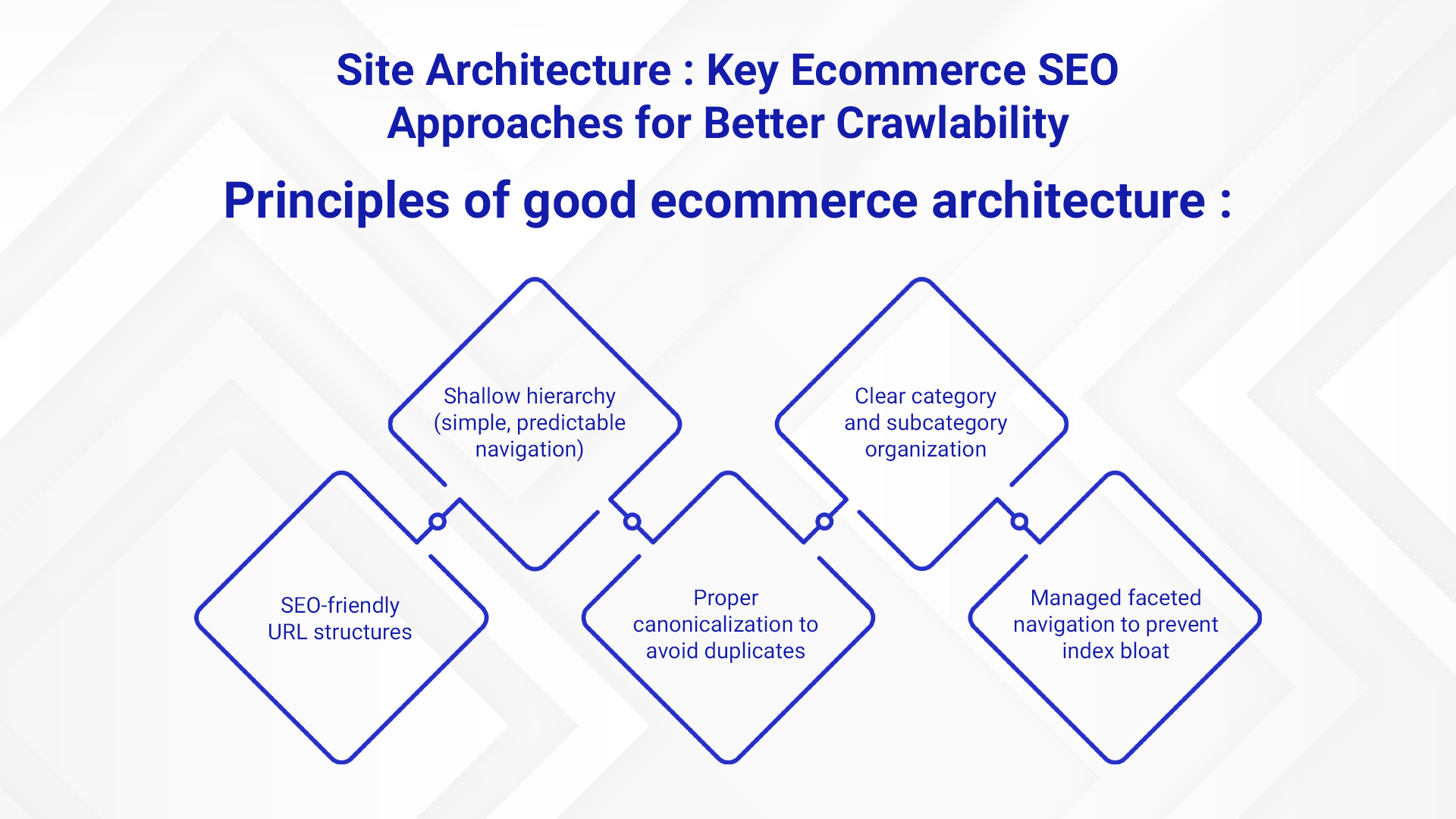
Principles of good ecommerce architecture:
- Shallow hierarchy (simple, predictable navigation)
- Clear category and subcategory organization
- SEO-friendly URL structures
- Proper canonicalization to avoid duplicates
- Managed faceted navigation to prevent index bloat
Good architecture fuels your SEO performance from the inside out, ensuring every page can be discovered, indexed, and ranked.
Technical SEO: Vital Ecommerce SEO Strategies for Peak Performance
Technical SEO acts as the driving force of your ecommerce website. Even the most well-written product pages struggle to rank if your site loads slowly or search engines cannot crawl it efficiently.
Site speed is a major deciding factor. Ecommerce shoppers bounce quickly if a page takes more than two seconds to load. Compressing images, reducing JavaScript, and enabling caching are simple but powerful improvements.
Mobile optimization is equally critical. With Google’s mobile-first indexing, your mobile site becomes the version evaluated for ranking. Ensure your layouts, buttons, and checkout flow are mobile-friendly and frictionless.
Structured data (product schema) helps your pages earn rich results—showing price, availability, and ratings directly in search results. This boosts click-through rates significantly.
Category Page Optimization Using Modern Ecommerce SEO Guides
Category pages often receive more organic traffic than product pages because shoppers search broader terms like “best office chairs” or “women’s sneakers.” These pages require more depth than just product listings.
Add an introduction at the top or bottom of the page describing what the category offers, who it’s for, and key features to consider. This helps search engines understand the page while helping customers make confident decisions.
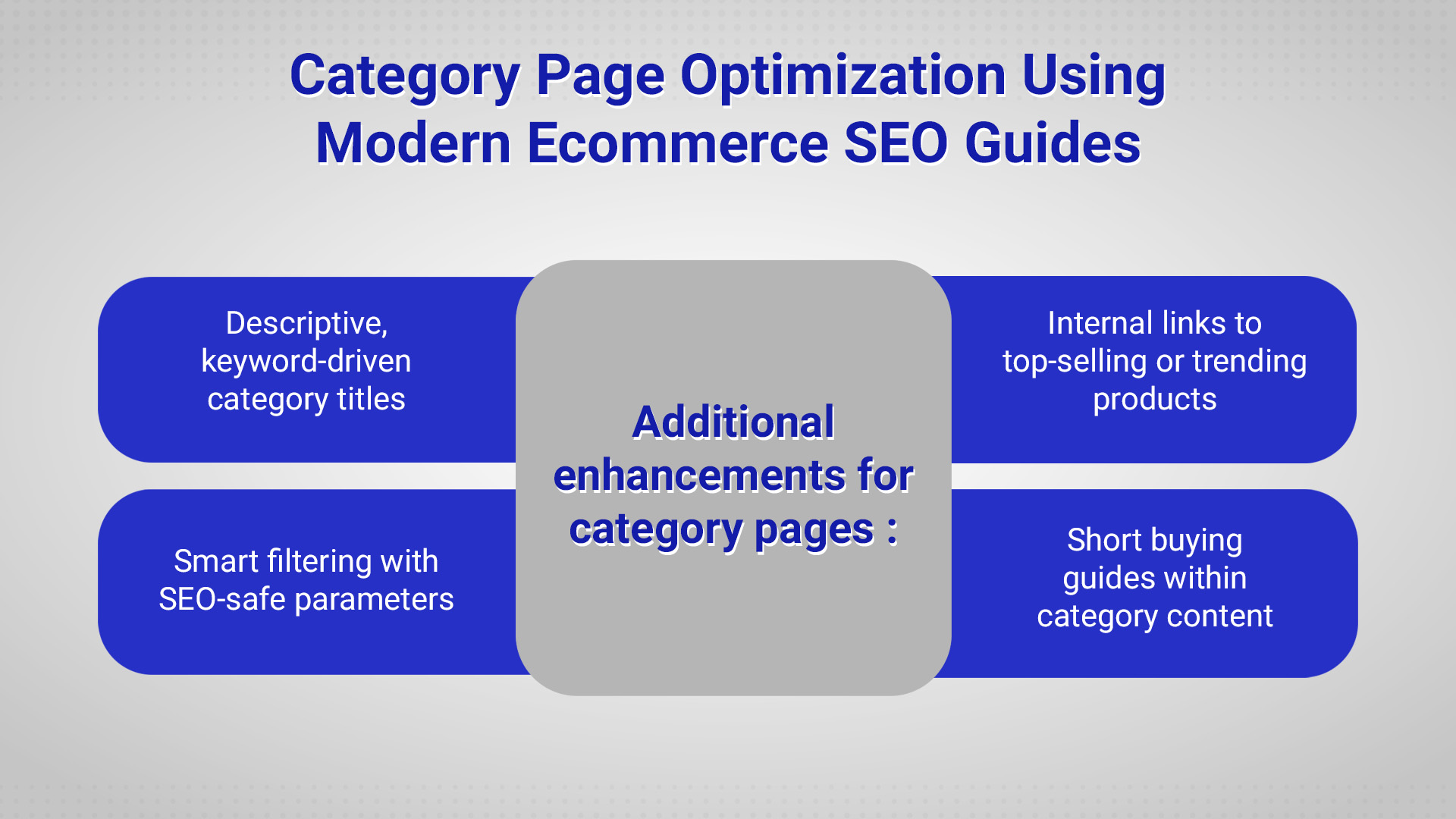
Additional enhancements for category pages:
- Descriptive, keyword-driven category titles
- Internal links to top-selling or trending products
- Smart filtering with SEO-safe parameters
- Short buying guides within category content
Categories act as SEO powerhouses when optimized properly.
Building Brand Authority With Strategic Ecommerce SEOTips
Backlinks remain a strong ranking factor, even in ecommerce. The challenge lies in earning links that are relevant, trustworthy, and valuable.
Guest posting on industry blogs helps position your brand as an expert. Meanwhile, digital PR campaigns—such as product launches, industry research, or expert commentary—help generate natural backlinks.
Broken link outreach also works extremely well for ecommerce brands. Find broken product links on other websites and suggest your product page as a replacement.
These authority-building techniques strengthen your domain and boost rankings across your store.
Local SEO Integration: Key Ecommerce SEO Tips for Hybrid Brands
Many ecommerce brands also operate physical stores or warehouses. Combining seo for ecommerce with local SEO has a compounding effect.
Add location-specific landing pages, optimize your Google Business Profile, and include local keywords where relevant. This increases visibility for local searches like “electronics store near me,” driving both online and offline sales.
Local citations, localized content, and reviews further build trust and strengthen your brand presence.
User Experience Signals: Dynamic Ecommerce SEO Hacks to Improve Rankings
Search engines observe how users behave on your site. High bounce rates, short sessions, and poor interactions hurt rankings.
Enhancing UX directly improves SEO.
A simple, intuitive navigation system encourages exploration. Displaying bestsellers, recently viewed items, and personalized recommendations keeps customers engaged. Meanwhile, clear shipping details, trust badges, and easy checkout remove friction.
Reviews also play a huge role. They build confidence, improve conversions, and add fresh content that boosts rankings.
Advanced and Intelligent Ecommerce SEO Hacks Using AI
Modern ecommerce SEO is evolving, and AI now plays a central role. AI tools analyze competitor gaps, cluster keywords, automate internal linking, and even fine-tune product descriptions based on user intent.
AI doesn’t replace human strategy but enhances it—making tasks faster, more accurate, and more scalable. This is especially beneficial for stores managing hundreds of SKUs.
AI-driven content optimization tools, predictive analytics, and automated SEO audits give you a competitive edge by uncovering insights traditional tools often miss.
Should You Hire an Ecommerce SEO Agency or SEO Consulting Services?
Managing ecommerce SEO alone can feel overwhelming, especially for growing stores.
An ecommerce seo service agency brings structure, systems, and deep expertise into your brand. Agencies handle keyword mapping, large-scale audits, content optimization, and link-building campaigns at a level difficult to replicate internally.
For brands needing strategic direction, seo consulting services offer tailored guidance, helping you avoid costly mistakes and accelerate performance.
Whether you choose an agency or consulting depends on your resources and growth stage, but both bring measurable ROI.
Conclusion
Ecommerce success is built on visibility, trust, and seamless user experience and SEO ties all of it together. With the right Ecommerce SEO Tips, you can transform your store into a search engine magnet, capturing buyers at every stage of their journey.
Use a balanced mix of on-page optimization, category improvements, technical strength, and authority-building strategies. Whether you execute internally or with an ecommerce SEO service agency, consistency is the key that unlocks sustainable, long-term organic growth.
Not getting the sales you expect?
Elevate your online visibility and boost your sales with expert Ecommerce SEO designed to drive consistent, high-quality traffic.
FAQs
Which ecommerce pages should I optimize first?
Start with category pages and top-selling products; they drive the most traffic and conversions.
How long does it take to see SEO results?
Most ecommerce stores notice significant improvements in 3–6 months.
Do reviews help with ecommerce SEO?
Yes, reviews improve Trust, CTR, and add fresh keyword-rich content.
Why is technical SEO crucial for ecommerce?
It ensures your store is fast, crawlable, mobile-friendly, and optimized for rich results.
Can AI tools help with ecommerce SEO?
Absolutely. AI boosts efficiency in keyword research, content creation, competitor analysis, and audits.
