




With AI models such as ChatGPT and Gemini on the rise, GEO is no longer just about location; it’s about how AI-driven search and localized experiences create real value online. AI is allowing businesses to connect with their audience in more relevant, personalized, and location-aware ways. What once was a tactical approach has now grown and will become a core component in how people discover, engage, and interact with brands in today’s digital society.
Because, among other things, search engines gradually turn into “answer engines” and mobile connectivity becomes the heartbeat of consumer behavior.
This blog explains the critical differences between GEO and SEO, clearly spells out why each is necessary in 2026, and goes on to give practical ways in which you can combine them to make your business triumph in this competitive environment.
The New Search Reality
In 2026, user behavior has shifted from “searching for information” to “demanding immediate solutions.” Whether it is an AI agent suggesting the best coffee shop around or a classic search engine ranking a B2B service provider, visibility is no longer about simply being on page one; it’s about being in the right place at the right time.
Now, Google and other search engines give more importance to E-E-A-T, or Experience, Expertise, Authoritativeness, and Trust. These are fueled by signals in the real world or AI-driven intent analysis. On the other hand, geo-marketing became a driver for “phygital” growth, a mix of physical and digital experiences.
GEO Marketing- Precision at Scale
GEO Marketing (Generative Engine Optimization) is the practice of optimizing content specifically for Large Language Models (LLMs) and generative search engines. It ensures that when an AI “thinks,” it chooses your data as the most relevant answer.
What it is in 2026:
- Citation Targeting: Moving beyond keywords to ensure that your brand is cited as a primary source in the AI summary.
- Intent-Fencing: Instead of having a radius, we set up a “fence” around specific user intents and complex searches so that your business comes up when a user asks for expert suggestions.
- Authoritative Signaling: Using structured data and verified citations to trigger “trust alerts” within an AI’s knowledge graph.
In the year 2026, GEO marketing will be thebenchmark standard of ROI, since it is intent-based, meaning it follows the intent through a conversation. When a user asks an artificial intelligence, “What is the best way to scale my IT infrastructure?” This is giving a high-intent signal, which is what GEO is intended to identify.
SEO - The Source of Organic Authority
While GEO is about being the “answer,” Search Engine Optimization (SEO) remains the master of the “source.” It is the strategic process of optimizing your digital presence to ensure your website remains a pillar of authority that AI engines want to pull from.
In 2026, SEO services for businesses focus on:
- Information Retrieval: Ensuring your site architecture is so clean that AI crawlers can effortlessly extract data for “AI Overviews.”
- Topical Authority: Moving away from “keyword stuffing” to “entity-based” content. In 2026, search engines rank “entities” (verified brands/people) rather than just words.
- User Experience (UX): With mobile driving over 62% of global traffic, site speed and “Core Web Vitals” are the baseline for any SEO strategy for businesses.
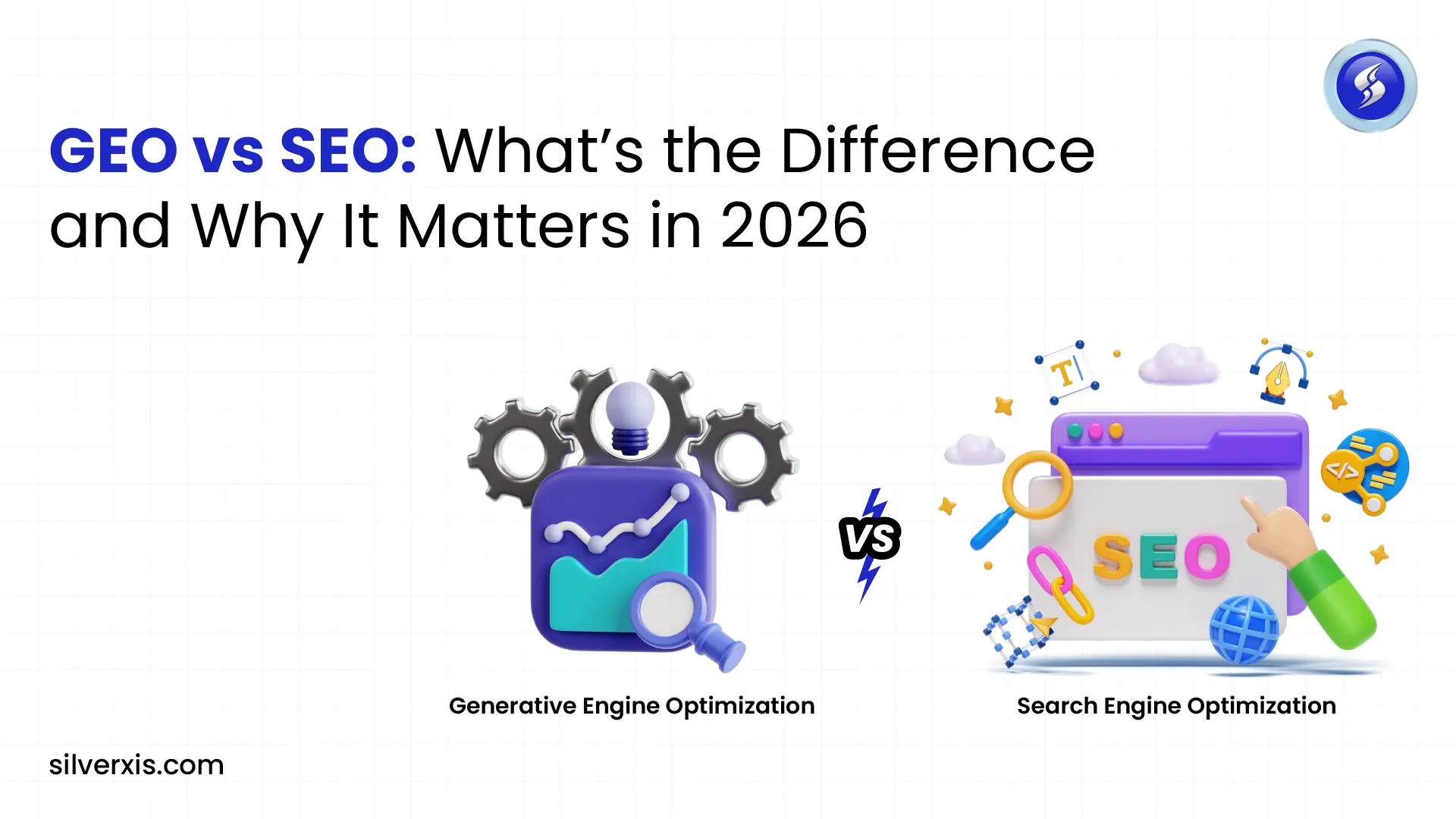
GEO vs. SEO: What is the Difference?
To build a winning strategy, you must clearly distinguish how GEO and SEO differ in execution and purpose. One gets you mentioned; the other gets you found.
Feature | GEO (Generative Engine Optimization) | SEO (Search Engine Optimization) |
Primary Goal | Become the “cited answer” in AI responses. | Build long-term authority and organic traffic. |
Visibility | AI-generated summaries and chat interfaces. | Traditional SERP (Search Engine Result Pages). |
Mechanism | Citation optimization and Natural Language. | Content, Backlinks, and Technical Health. |
Timeline | Instant relevance (Real-time AI learning). | Long-term (Compounding results). |
Cost Basis | Targeted content and citation strategy. | Primarily investment in content & tech infrastructure. |
The Benefits of GEO Marketing Services
For businesses looking to capture the “Zero-Click” generation, GEO marketing services are the ultimate conversion tool.
- Natural Language Reach: Your audience isn’t “IT staffing”; it’s the intricate questions people pose to their AI assistants at 2:00 PM on a Tuesday.
- Real-time Relevance: With AI and GEO by 2026, your content’s visibility can change dynamically according to trending topics or sentiment in the online community.
- Response Generation: Statistics show that 41% of users now trust AI-summarized recommendations over traditional ads.
SEO Benefits: The 2026 Outlook
Traditional SEO has evolved into Search Everywhere Optimization. If your business isn’t optimized for organic search, you simply don’t exist in the AI’s “knowledge graph.”
- AI Search Visibility: To be cited by ChatGPT or Gemini, your site must have a clean structure and verified facts. This is the new definition of “ranking.”
- Cost-Effective Longevity: A high-ranking organic page continues to drive leads for years compared to the fleeting nature of paid digital ads.
- Building Trust (E-E-A-T): In an era of AI-generated noise, 2026 consumers crave human-led expertise. SEO allows you to showcase the credentials, original research, and case studies that prove your value.
Also Read: How Businesses Can Leverage SEO and Digital Marketing for Maximum Growth
When is GEO Marketing the Most Effective
Lead with GEO marketing when you are in industries that require immediate trust and direct answers:
- Consulting & Professional Services: Providing instant answers to complex “How-to” queries.
- Tech & SaaS: Being the recommended solution when users ask for feature comparisons.
- High-Volume B2C: Driving immediate brand awareness through AI-driven recommendations.
When SEO is the Priority
Invest heavily in SEO services for businesses when:
- Long-term Brand Building: You want to be the “go-to” authority that AI engines always reference.
- Deep-Funnel Research: Your audience demands long-form whitepapers and in-depth blogs to make a purchase decision
- National/Global Expansion: Your goal is to own the organic space across multiple search platforms.
Combining GEO + SEO: The Power of "Phygital" Logic
In 2026, the most successful brands don’t choose one; they integrate both. We call this a “Phygital” approach to data, merging your Physical authority with Digital generative relevance.
Imagine a user searches for the “best IT staffing agency for 2026.”
- SEO ensures your deep-dive blog on “Future Tech Hiring Trends” appears in their research phase.
- GEO ensures that when the user asks an AI, “Summarize the top agencies from that list,” your brand is the first one cited with a “Verified” badge.
Best Practices for 2026
To stay ahead of the digital competition, follow these SEO ranking factors for 2026:
- Hyper-Personalization: Use AI to tailor content not just to a query, but to the user’s specific industry “feel” and intent.
- Key Conversational Keywords: Optimize for “How do I…?” and “Why should I…?” since voice and AI search engine optimization are now the primary search methods.
- Entity Clarity: Ensure your brand’s name, experts, and mission are consistent across all business listings and citation sources. AI “connects the dots” to verify your existence.
Lead the Future with SilverXis
Whether you are a local enterprise looking to drive more traffic to your digital storefront or an international business aiming to attain the highest ranking on generative engines, a data-intensive strategy is critical to establishing your influence.
At SilverXis, we are experts at coupling traditional SEO with cutting-edge GEO marketing. We understand that in 2026, being “on the web” isn’t enough; you have to be part of the conversation.
Are you prepared to take charge of your market?
Grow faster in 2026 with our GEO marketing services or boost your organic presence with our expert SEO services for businesses.
FAQs
What is a digital transformation roadmap?
A digital transformation roadmap is a strategic plan that outlines the phases, projects, and resources required to transition a business from its current operational state to a desired, digitally-enabled future state. It serves to align technology investment with core business objectives.
How do I conduct a digital maturity assessment?
A digital maturity assessment involves auditing your current technology stack, processes, and organizational culture. You identify technological gaps, measure the current level of digital skill in your workforce, and pinpoint business processes that are bottlenecks, using this information to prioritize transformation efforts.
What are the key digital transformation stages?
The key digital transformation stages typically include: Assessment (understanding the current state), Strategy Definition (setting goals and KPIs), Implementation (modernizing processes and adopting new tech), and Optimization (continuous measurement and scaling).
What are some common digital transformation benefits?
Common digital transformation benefits include increased operational efficiency through automation, a superior customer experience via personalized services, reduced operational costs, and enhanced decision-making capabilities due to real-time data analytics.
Why is change management strategy important for digital transformation?
A strong change management strategy is crucial because digital transformation impacts people and processes, not just technology. It ensures employee buy-in, addresses resistance, provides necessary training, and fosters a digital-first culture, ensuring new systems are actually adopted and utilized effectively.
