These days, businesses see data as a real game-changer. It’s what sets them apart. Companies everywhere are pouring resources into data analytics services, hoping to dig up insights that actually guide their big decisions. When organizations lean on data-driven decision making to make choices, they spot fresh opportunities, work smarter, and stay ahead, especially as the market keeps shifting.
So, what’s really happening? Businesses are taking predictive analytics and turning it into their secret weapon. They’re rolling out business intelligence tools and tapping into modern analytics consulting services to get more from every level of the company. Whether it’s smarter marketing, sharper financial forecasts, or better operations, forward-thinking organizations are rewriting the rules of success with analytics.
What Is Enterprise Data Analytics and Why It Matters in 2025
Enterprise analytics isn’t just a back-office function anymore. Now, it’s the driving force behind real innovation. With powerful enterprise data management and real-time analytics platforms, companies can finally turn piles of raw data into insights that actually matter. Faster decisions, smarter moves, and a real shot at outpacing the competition.
Descriptive vs Predictive vs Prescriptive Analytics
Types of Analytics | Purpose | Description |
Descriptive Analytics | Understand what has happened | Tells you what’s already happened using historical data. |
Predictive Analytics | Anticipate future outcomes | Looks ahead and forecasts what’s coming based on trends and patterns. |
Prescriptive Analytics | Recommend Actions | Goes a step further, guiding decisions with advanced models and machine learning insights. |
Businesses often use all three analytics types in a continuous loop, collecting data, learning from it, acting on it, and repeating the process for improvement.
The ROI of Data Analytics Services
Analytics isn’t just a buzzword—it pays off fast. Firms investing in data analytics services see results in the first year. According to Gartner, these companies speed up decision-making up to three times and cut costs by automating processes, KPI tracking, and monitoring performance more closely.
Common Myths About Business Intelligence
It’s only for big companies: That’s not true anymore. Cloud-based tools make it possible for even the smallest businesses to use powerful analytics without needing a huge budget.
It’s way too complicated: That used to be the case, but not now. Modern tools are easy to use. Just drag, drop, and explore your data. You don’t need a data science degree to get value from them.
It costs a fortune: Not really. You can start with a basic plan and pay as you grow. As your business expands, you simply add more features when you need them.
Only the top executives need it: Insights help everyone from sales and marketing to HR and operations. When each team understands the data behind their work, smarter decisions follow.
5 Ways Leading Companies Use Data Analytics to Drive Growth
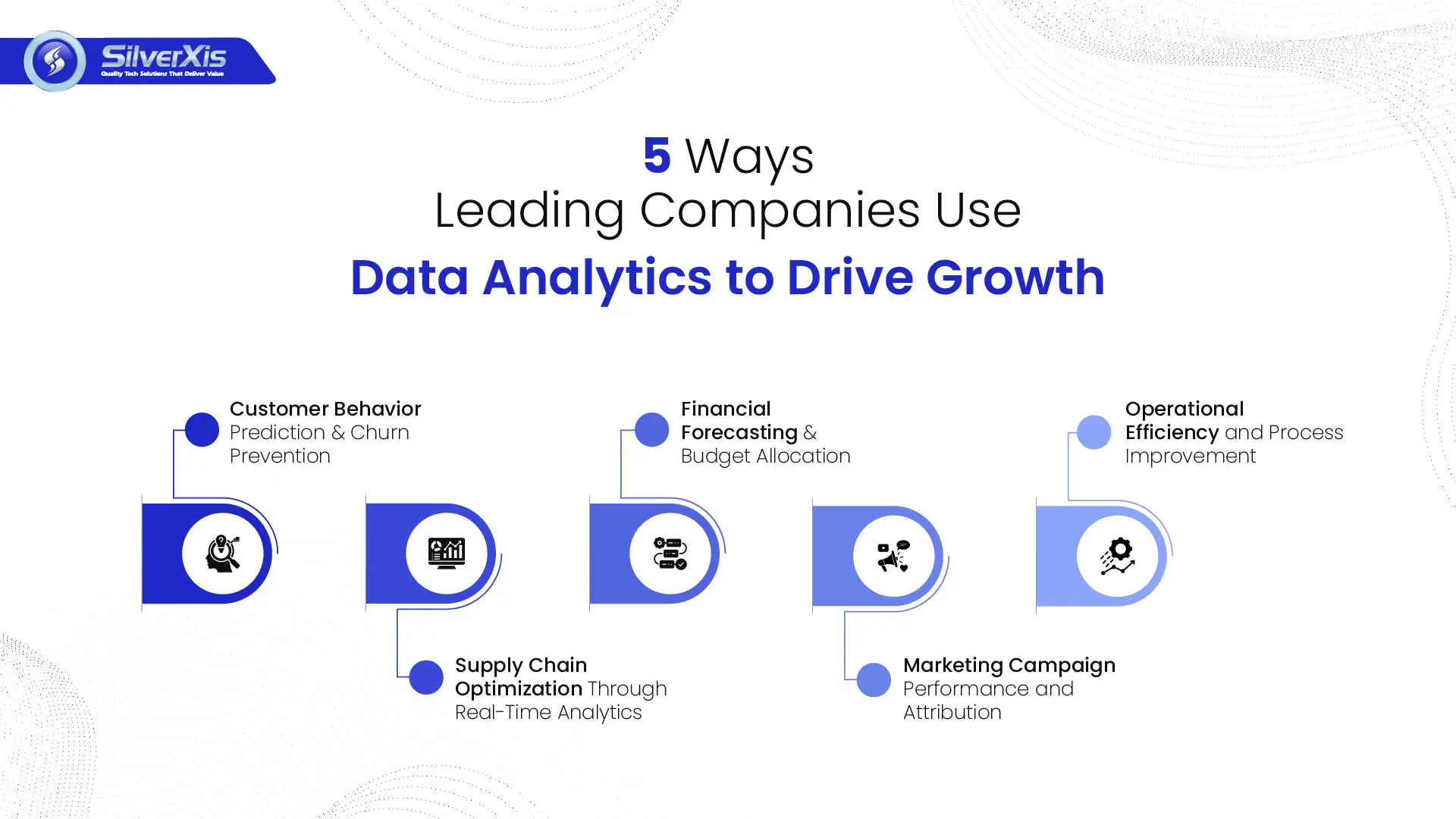
Across every industry, organizations are using data analytics services to work smarter, serve customers better, and boost revenue. Here’s what the best of the best are doing right now:
Customer Behavior Prediction and Churn Prevention
Predictive analytics lets companies spot when customers might leave—sometimes before those customers even realize it themselves. By analyzing patterns and engagement, retention teams step in early, keeping people happy and boosting lifetime value.
Supply Chain Optimization Through Real-Time Analytics
Real-time analytics platforms track every link in the logistics and production chain. When the system spots a delay or a sudden change in demand, companies can adapt instantly, keeping things running smooth and cutting down on waste.
Financial Forecasting and Budget Allocation
Finance teams use business intelligence tools to map out revenue, watch spending, and track ROI across every department. With forecasting models, leaders can see different scenarios play out and make decisions confidently—even when the market gets bumpy. These insights enable stronger data-driven decisions across the business.
Marketing Campaign Performance and Attribution
Marketers lean on analytics consulting services and data visualization dashboards to see which campaigns actually work. They shift budgets on the fly, using data from ETL processes and ROI measurement to make sure every dollar spent pushes growth forward.
Operational Efficiency and Process Improvement
By connecting their enterprise data management systems to intuitive dashboard development tools, companies spot bottlenecks and fix them fast. These process improvements add up, often slashing operational costs by as much as 25%.
Essential Components of a Modern Data Analytics Stack
If you look at the top companies in 2025, you’ll see they all have one thing in common: a tightly integrated data analytics stack. It’s not just about collecting numbers anymore. They use powerful infrastructure, clever tools, and AI engines working together behind the scenes.
Data Collection and Integration Tools
Everything starts with getting your data in order. APIs and ETL processes connect all your systems—CRM, ERP, customer platforms—so every business metric ends up in one place. No more scattered reports or endless spreadsheets.
Cloud Data Warehousing Solutions
Then you need somewhere to put all that data. Cloud analytics and data warehousing solutions store massive amounts securely and let you pull up what you need in seconds. You can scale up as you grow, and you won’t get bogged down no matter how much information you throw at it.
Business Intelligence and Visualization Platforms
Next comes the fun part: turning raw data into real stories. Business intelligence tools and data visualization dashboards take complex information and make it actually useful. Suddenly, KPIs and ROI aren’t just numbers—they’re clear, visual, and right in front of you. Executives get what’s going on instantly through powerful ROI measurements.
AI-Powered Predictive Models
And then there’s AI. Forecasting analytics dig through your data and spot trends before anyone else even sees them coming. These systems use machine learning insights to constantly learn and adjust, fine-tuning your strategy as things change in real time.
Industry Success Stories: Analytics in Action
Analytics isn’t just a buzzword. It’s changing the game across every industry.
Healthcare: Reducing Patient Wait Times by 40%
Hospitals use data analytics services to manage beds and predict patient flow. The result? Patients see doctors faster, and wait times drop—sometimes by nearly half.
Retail: Increasing Conversion Rates Through Behavioral Analytics
Retailers dive into purchase data using predictive model to deliver personalized recommendations. Customers get what they want, conversion rates go up, and inventory stops gathering dust.
Manufacturing: Predictive Maintenance Saving $2M Annually
Manufacturers use instant data processing to spot equipment problems before they turn into breakdowns. That means less downtime and millions saved every year.
Financial Services: Fraud Detection Saving $5M+ Per Year
Banks and financial firms rely on analytics consulting services and AI-driven intelligence platforms for anomaly detection. AI-powered data warehousing helps flag fraudulent activity the moment it pops up.
How to Get Started with Data Analytics Services
No matter your company size, getting serious about analytics starts with a clear plan. Implementing data analytics services sets the foundation for transformation and measurable success.
Conducting a Data Maturity Assessment
First, figure out where you stand. A data maturity assessment shows how ready you are—looking at your data management, systems, and even company culture. It helps you spot gaps and set real, trackable KPI tracking goals.
Choosing Between In-House vs Outsourced Analytics
You have a choice: build your own analytics team or work with outside experts. Doing it in-house gives you more control, but partnering with analytics consulting services gets you up and running faster, especially when you want advanced live data analytics platforms right away.
Building Your Analytics Roadmap (3-6-12 Month Plan)
Lay out a real plan. In the first three months, focus on dashboard development and data visualization. By six months, bring in cloud analytics and machine learning insights. After a year, aim for full-scale enterprise data management with automated reporting.
Common Data Analytics Mistakes and How to Avoid Them
Honestly, the hardest part of analytics isn’t the tech, it’s how people think about it.
Top Data Analytics Mistakes
- Jumping into buying tools before defining clear goals.
- Choosing technology without aligning it to business needs.
- Ignoring data quality and letting information become messy.
- Overlooking team training and adoption.
How to Avoid Them
- Start with a clear plan and set specific, measurable goals.
- Pick tools that truly fit your business objectives and systems.
- Keep your data clean, organized, and up to date.
- Train your team so they understand and actually use the analytics tools.
The Future of Analytics: AI, Edge Computing, and Real-Time Insights
Analytics is speeding up. Predictive analytics is now teaming up with edge computing, so you get fast, local insights—not just a pile of reports. Real-time analytics platforms powered by AI mean you can react instantly to whatever the market throws at you. The companies that win tomorrow will treat data as more than just numbers. They’ll use it as fuel for innovation and lasting leadership.
Conclusion
Data isn’t just something your business produces—it’s at the core of everything you do now. The right mix of data analytics services, AI-driven intelligence platforms, and forecasting analytics helps you see what’s coming and act on it immediately. The future belongs to organizations that embrace data-driven decision making and use analytics to create real value everywhere they operate.
Ready to turn your enterprise data into predictive insights? Get a free data analytics assessment from SilverXis.
FAQs
What's the cost of data analytics consulting services?
Prices vary based on your project’s size and how complicated your data is. For big enterprise projects, expect anywhere from $30,000 up to $200,000, especially if you need dashboard development, automation, or cloud analytics built in.
How long does it take to see ROI from analytics?
Most companies start to see returns within six to twelve months. It really depends on how ready your data is, how you handle your ETL processes, and how you track KPIs using business intelligence tools as part of your data analytics services.
Do small to mid-sized businesses need full analytics services?
Absolutely. Even smaller companies benefit from data-driven decision making. Scalable data visualization dashboards and cloud analytics platforms have made top-tier insights more affordable and easier to roll out than ever before.